Textile Documents › Publications › Publication: Harper & Brothers
2 documents found
Sort: 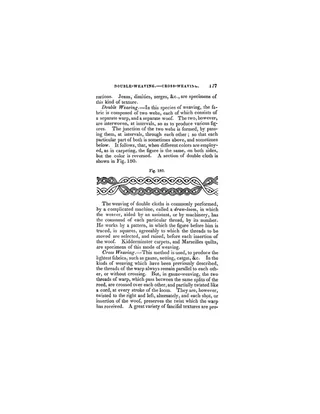
"Arts of Combining Flexible Fibers" in The Useful Arts Considered in Connection with the Application of Science, Vol. II
Monograph · 24 pages
Chapter XVIII of Jacob Bigelow's 'The Useful Arts Considered in Connection with the Application of Science' (1856), covering the arts of combining flexible fibres. It begins with the theory of twisting, rope making and hemp spinning, then describes cotton manufacture stage by stage: batting, carding, drawing, roving, spinning, mule spinning, warping, dressing and power weaving. Short sections cover twilling, double weaving, cross weaving (gauze), lace, carpeting, tapestry, velvets, linen, woollens, felting, paper-making and bookbinding. Four small figures show cloth sections (plain, twill, double cloth, gauze, loop-pile), and a list of works of reference closes the chapter.
The Development of Embroidery in America
Book · 195 pages
Candace Wheeler's 1921 history of needlework in America, from Native American quillwork and the arrival of the Puritans through the late nineteenth century. Chapters cover colonial crewelwork, samplers and quilts, Moravian embroidery and portraiture, French embroidery, lacework, Berlin woolwork, the revival of embroidery and the Society of Decorative Art, American tapestry, and the Bayeux Tapestry. It is illustrated with about 36 photographic plates of samplers, bed hangings, Moravian pictures, fire screens, baby caps, wedding garments and lace, many credited to museums and families. It includes some discussion of dyeing, homespun linen and the relation of cross-stitch to weaving.