Textile Documents › Publications › Publication: Moody's Magazine
6 documents found
Sort: 
Cotton Association vs. The Cotton Exchange
Article · 3 pages
A 1907 article in Moody's Magazine on the dispute between the Southern Cotton Association and the New York Cotton Exchange. The author argues that speculation, and short selling in particular, does not depress cotton prices, and that overtrading by Southern speculators buying on margin has done the most harm. He concedes that the Exchange's grading methods have some flaws, argues that supply and demand ultimately set prices, and says 10 cents a pound is a fair price.
Cycles of Cotton Speculation
Article · 4 pages
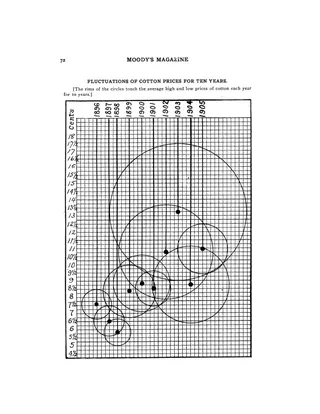
A 1906 magazine article by financial writer Thomas Gibson analyzing ten years of American cotton prices (1896 to 1905) for speculators. It presents tables of seasonal high, low and average prices and of crop sizes in bales, plus a circle chart of yearly price fluctuations. Gibson argues that cotton prices have risen steadily despite normal or large crops, attributing this to a general rise in commodity prices and a declining purchasing power of the dollar rather than to supply and demand.
Gold Supply and Cotton Prices
Article · 3 pages
A 1907 article by cotton market analyst Theodore Price arguing that the doubling of both American cotton production and price since 1896 is explained by rising world gold production, which cheapened gold relative to labor-based goods. He lays out nine numbered propositions, forecasts higher prices for cotton and other necessities, and closes with supply and export statistics for the 1906-07 American crop.
Russian vs. American Cotton Mills
Moody's Magazine, 1905-1906
Article · 1 page
A short 1905-06 magazine piece on the outlook for American cotton goods in Eastern markets after the Portsmouth treaty ended the Russo-Japanese War. It argues that past Russian export competition depended on government subsidies and rebates, and that America's water route gives it a natural advantage. It also holds that Russia's loss of Manchuria and its shortage of funds should reassure American manufacturers, though Russia's political instability makes forecasting difficult.
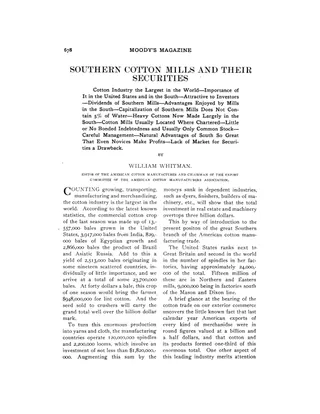
Southern Cotton Mills and their Securities
Article · 4 pages
A 1905-06 article from Moody's Magazine by William Whitman, editor of the American Cotton Manufacturer, assessing Southern U.S. cotton mills as investments. It gives world cotton crop, spindle and loom statistics, then lists the advantages of Southern mills: nearby cotton, cheap fuel, water power, low costs, and unwatered capitalization. It also covers the drawbacks: inexperienced managers, small mills, and no ready market for mill shares.
Unique Wool Market
Moody's Magazine, 1905-1906
Article · 2 pages
A short 1905-06 magazine article on the U.S. wool market, which it calls unique because stocks in eastern markets are the smallest the trade has known. It describes manufacturers adulterating woolen fabrics to hold down prices, and a few large Boston houses gaining unusual control of the wool supply. It also explains why wool cannot be cornered like cotton or wheat, since each lot is sold on its own merits, and notes the 1905 purchases of wool on the sheep's back.
6 documents found